
I am writing these lines on my way to Bangkok for the IMF Annual Meetings, before heading to China for a few more meetings and conferences. What I have been writing about European and Franco-German defence cooperation – or the lack thereof – for the past two years has been confirmed yet again: with Germany’s withdrawal from the Franco-German tank project MGCS now openly discussed by French army officials. I have been saying repeatedly that this would happen, so it comes as no surprise. But unlike the Franco-German fighter jet programme, where I think the blame lay primarily with France and Dassault, in this case the blame lies squarely with Germany. It sends an important message: even where Germany is the outright winner of a deal, it prefers to go it alone.
But this week I will focus on the upcoming European Council meeting and EU–China relations. In particular:
1. What to make of the EU–China deal on hybrid vehicles, and the way forward
2. The anti-coercion instrument versus the Franco-German “kill switch”
3. France: Krugman’s pension argument, and who is actually exposed to French debt
+++++++++
1. The EU–China hybrid deal: halved compared with what?
The last-ditch effort by Maroš Šefčovič to find a deal with China after the Franco-German non-paper seems to have paid off but the question is how effective it will be? As usual with these agreements, the devil is in the details, and effectiveness will depend heavily on enforcement. It is worth remembering that the EU struck a deal with China on solar panels in 2013, and that enforcement was so poor that there is no European solar panel industry left to speak of.
This time, the headlines claim that China agreed to “halve” its hybrid exports to the EU deserves a closer look. It is not clear what benchmark the halving is measured against: a projection, or actual exports? At his press conference in Beijing, Šefčovič said China would halve exports of hybrids and plug-in hybrids over four years compared with projected levels, keeping “several million” cars out of the EU. The Chinese text says only that both sides reached an understanding on hybrid trade in a WTO-consistent manner, with no volume, reduction, time frame or tariff.
China exported roughly 500,000 hybrids to the EU last year, and Eurostat data show 217,764 PHEVs and 160,662 HEVs imported in the first seven months of 2026. Annualising the last three months, the total is closer to 820,000. Bloomberg reports that under the agreement, imports are to fall to 400,000 hybrid vehicles a year, against the roughly 800,000 the Commission expects for 2026. So the cap would be set at roughly half the recent run-rate, and below half on the 350,000 figure I understand was agreed (see below). But the forgone volume depends on the baseline: if imports had kept growing in line with Chinese car imports to the EU over the last three years (about 25% a year), a cap starting at 350,000 and rising 6% a year would keep around 4.2 million cars out over 2027–30, consistent with Šefčovič’s “several million”, and by 2030 imports would be almost 80% below baseline rather than half (Figure 1).
My understanding / information set is more specific: The arrangement consists of a quantitative limit on hybrid vehicles (HEVs and PHEVs) imported from China into the EU to be implemented through a multilateral safeguard measure imposed by the EU. The quantitative limit for the first 12-month period will be set at 350,000 units. The quantitative limit will increase by 6% annually from the second year of application. The rate of increase mentioned above will be applied equally to all sources of imports of the EU every year.
Beijing has essentially agreed not to retaliate. Country-specific safeguards are typically not WTO-compliant, but there is an easy workaround: apply the safeguard to all hybrid imports, with generous quotas for countries other than China. Conceptually, this would also allow the limits to extend to future Chinese production elsewhere in the world.
It is important to note, however, that the understanding does not cover EVs, so we are likely to see a significant surge in Chinese BEV exports to the EU, even though these are subject to countervailing duties. China-made BEV imports have been broadly flat since 2023, at around 430,000–440,000 a year, but the range of outcomes to 2030 is wide (Figure 2): from below 400,000 if price undertakings bind and local assembly displaces imports, to around one million if exports grow in line with the CPCA’s 20% forecast, and close to 1.5 million if part of the restrained hybrid volume is redirected to BEVs. My best guess is that we will see negotiations and a deal on price undertakings with EV carmakers, to achieve the equivalent of the quota system that safeguards achieve on hybrids but in the meantime, we will see considerable EV exports growth to Europe.
What is interesting is that the Commission describes the agreement as “an operational proof of concept that could, where appropriate, be replicated in other sectors”, so we will need to watch what comes out of future trade talks, with a ministerial follow-up due by January 2027 and the next Trade and Investment Consultation in March 2027. The rest of the package is thin: duty savings on EU exports of at least €225m a year against a €360bn deficit, and some rather vague language on facilitating export licences for rare earths.
China indicated that it will explore ways to facilitate exports to the EU including covering more EU end-users in its rare earths and permanent magnets general licences. Parties also agreed to notifying each other well in advance when it comes to the listing of entities subject to export control restrictions. Both sides expressed the view that listings should be based on national security and non-proliferation grounds and supported taking steps to delist entities, consistently with their applicable legislation.
Figure 1 · Chinese hybrid exports to the EU under the safeguard quota (350,000 in year one, +6% a year)
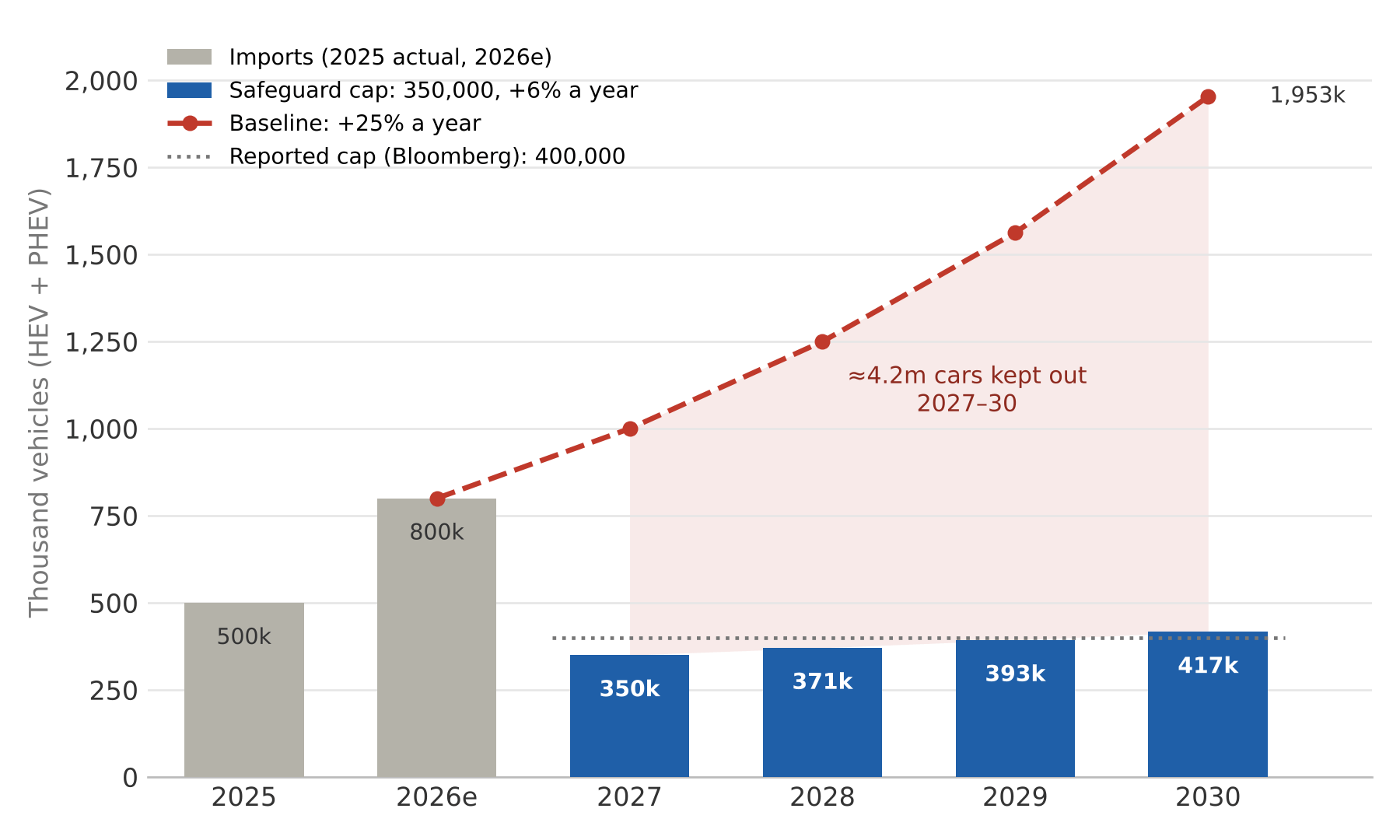
Sources: Eurostat, Bloomberg, author calculations. 2025: approximate (~500,000 hybrids). 2026e: ~800,000, the level the Commission briefed as expected for 2026. Cap path assumes the first 12-month period covers 2027: 350,000 (2027), 371,000 (2028), 393,000 (2029), 417,000 (2030). Baseline grows 25% a year from 2026e. Dotted line: 400,000 cap reported by Bloomberg.
Figure 2 · China-made BEV imports into the EU: history and scenarios to 2030
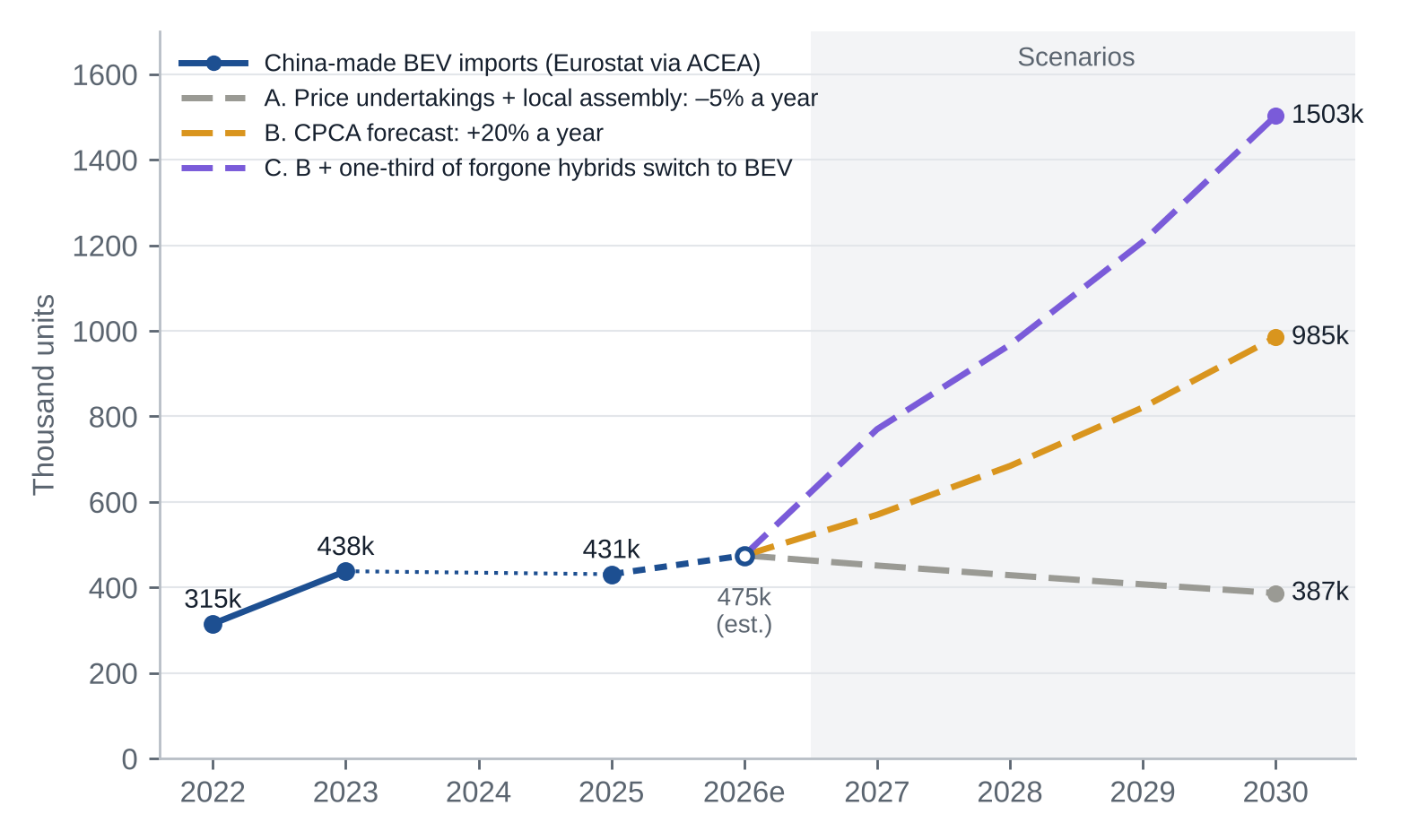
Sources: Eurostat via ACEA (2022: ~63% of just over 500,000 cars imported from China; 2023: 438,034; 2025: 42.9% of 1,002,742, i.e. ~430,000); CPCA; author calculations.
Cars made in Europe fall outside the deal, and pushing Chinese brands to produce locally is the EU’s stated hope. Europe played this game with Japan in 1991, with an export restraint that lasted until the end of 1999 and coincided with the arrival of Nissan Sunderland and Toyota Burnaston. A follow up to what the US did with Japan in the late 80s. Chery’s joint venture with Ebro in the former Nissan plant in Barcelona targets up to 130,000 vehicles a year, and Chery is now in talks to build cars at Sunderland in lieu of Nissan – history rhyming. Most Chinese capacity under construction in Europe is battery-electric, so it substitutes for tariffed BEV imports rather than for restrained hybrids (Table 1).
I continue to believe that we will see more Chinese investment in Europe, and that this is the best way to redress the large bilateral imbalance, provided we can agree on a framework for foreign investment that maximises local employment, local content and technology transfer. This is what the IAA is supposed to achieve, but it is hitting roadblocks in Parliament, from the CDU/EPP. It is not clear that we will see the same level of Franco-German convergence on the IAA as we have had on trade defence instruments. This is a critical development to follow.
Table 1 · Chinese car assembly in Europe: existing and planned sites
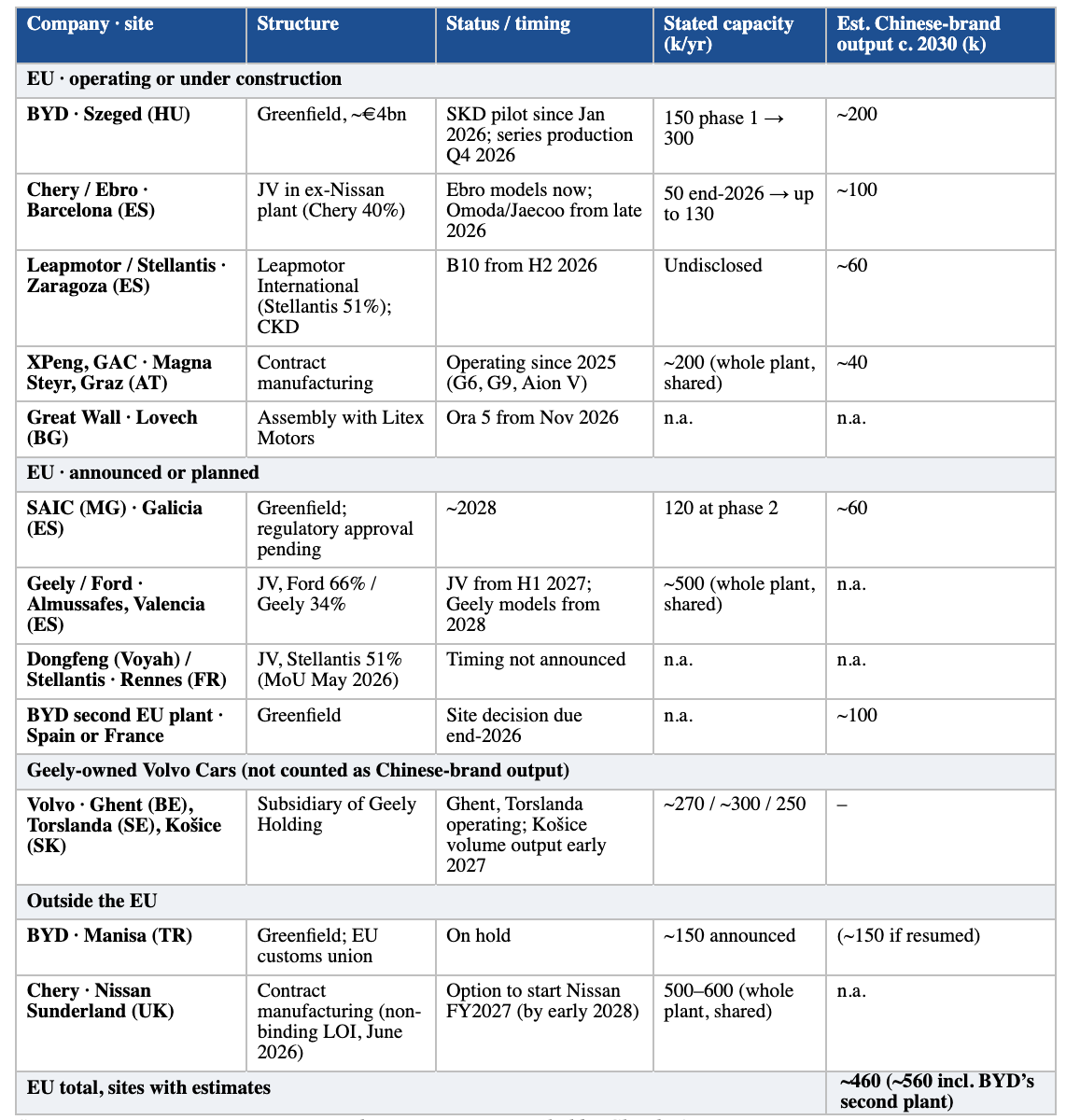
Sources: company announcements and press reports compiled by Claude AI.
2. The anti-coercion instrument versus the Franco-German “kill switch”
Macron and Merz’s letter and joint non-paper calling on the Commission to adopt a new trade defence strategy was pivotal. The letter specifically asks for a credible instrument that enables a decisive, systemic response: powerful measures that can be triggered through reverse qualified majority and could extend to immediate exclusion from the internal market.
There is no reference to China, but the references to structural overcapacity, dumping, subsidies and currency undervaluation leave little doubt. The key question for me is why a new instrument is needed when the Commission could easily have used its Anti-Coercion Instrument, adopted in 2023 and never used – not even when Washington threatened tariffs over Greenland in January.
The two instruments differ on several dimensions (Table 2), but essentially the Franco-German tool is likely to be pushed at the October EUCO because it is an important deterrent. As we have seen with the US, it is hard to assemble a qualified majority of member states to activate the ACI. Today Spain, Hungary and potentially others would object for fear of Chinese retaliation, and France and Germany wanted an instrument they can activate without having to form a majority.
Table 2 · Anti-coercion instrument vs. “kill switch”
Anti-Coercion Instrument (Reg. 2023/2675)
Franco-German “kill switch” (proposal, 5 Oct 2026)
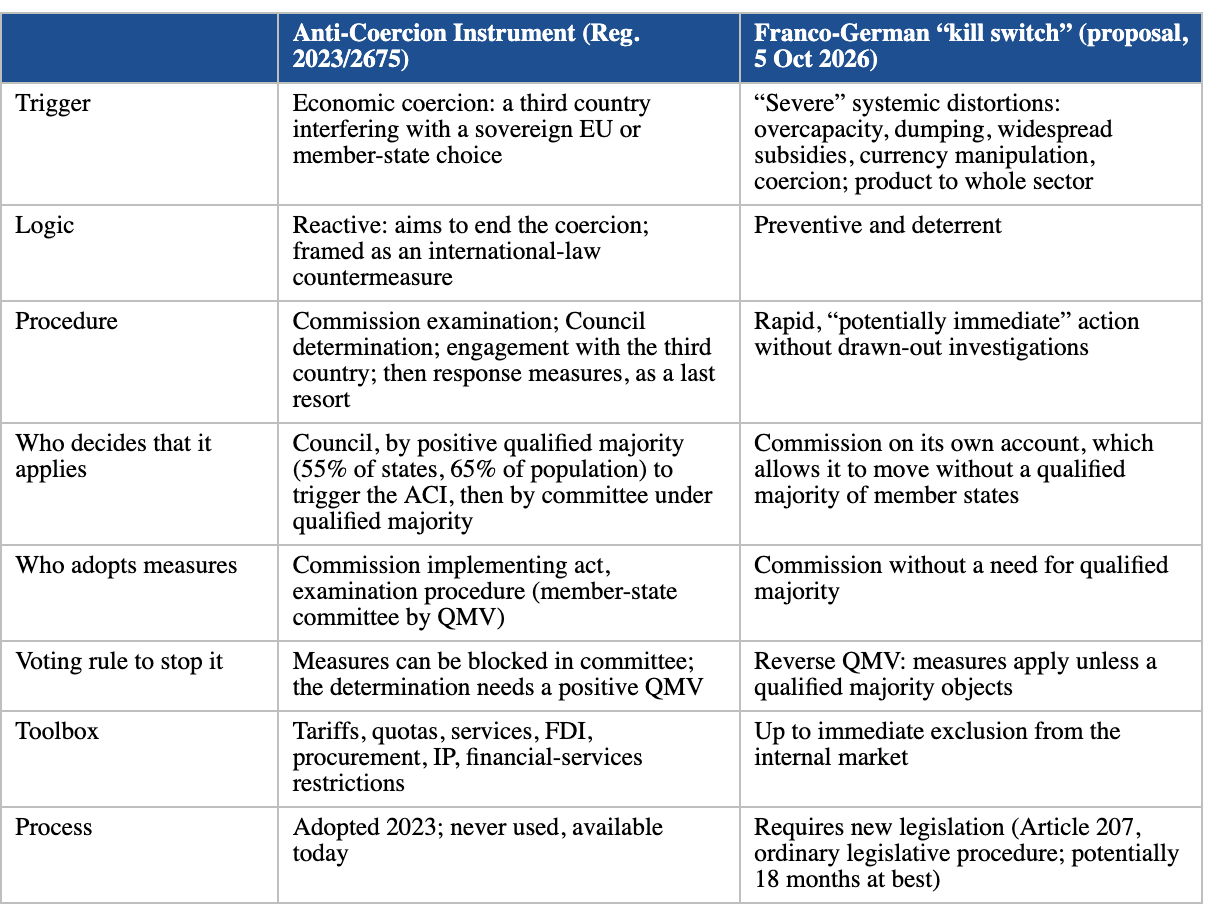
Sources: Regulation (EU) 2023/2675; Macron–Merz letter and joint paper of 5 October 2026.
Legal anchor. The ACI is framed as a countermeasure under public international law, a response to a wrongful act. A tool aimed at “distortions” has no equivalent anchor and looks, as many have noted, like an EU version of the US Section 301.
Reverse QMV is the real innovation, and it shifts power to the Commission: a determined minority of member states with China exposure (Germany’s carmakers until recently, Spain, Hungary) could no longer block action. But establishing the new instrument requires ordinary legislation under Article 207, meaning a qualified majority in Council and a majority in Parliament, which takes time and may face resistance or delay from those same member states.
From Beijing’s perspective, the safeguard deal is not so bad, and it can be a useful “proof of concept” if it helps reach cooperative solutions in other sectors. Whether leaders adopt these ideas at the EUCO on 15–16 October, or merely “take note”, will tell us how united the rest of the Council is behind France and Germany, and whether Europe is building a real instrument or a mere bargaining chip.
3. France: Paul Krugman’s pension argument, and banks’ exposure to French debt
Paul Krugman’s post this week is rather unusual by his standards. His argument is simple: France is on a fiscally unsustainable path, running large deficits without a war, recession or pandemic to justify them, while an ageing population means pension costs will grow faster than revenue. ECB President Lagarde suggested as much when she said that “when your debt is close to 120% of GDP and not on course to be brought under control, it’s a serious matter” (interview with La Croix). Luis Garicano agreed, adding that both Le Pen and Mélenchon have so far blocked sensible pension reform, which makes any intervention politically impossible for France’s partners and therefore makes France “too big to save”. I disagree with this conclusion.
Le Pen’s golden rule, which I discussed at length last week, may force her to choose between her pension promises and her fiscal rule. But I disagree that France is “too big to save”. I have no doubt that the ECB could stabilise the OAT market if it chose to. The Transmission Protection Instrument exists, and even without it, it would probably not take much (an end to QT, a structural asset purchase programme as part of the new operational framework) to move the market very significantly. But indeed we are not there yet.
The question is the trigger and eligibility: TPI requires compliance with the EU fiscal framework. France is under an excessive deficit procedure but the Commission currently considers France in abeyance with the EDP, which means compliance lies somewhat in the eye of the beholder. More importantly, any material intervention would require a French government politically able to commit to a credible fiscal path. The real here question is whether the presidential and legislative elections will deliver that, or another hung parliament and political deadlock like today’s.
In the short term, and probably until the elections, what matters most is who the marginal buyer is, and the extent to which domestic savings can weather the shock of forced foreign selling likely to come with higher volatility and rating downgrades.
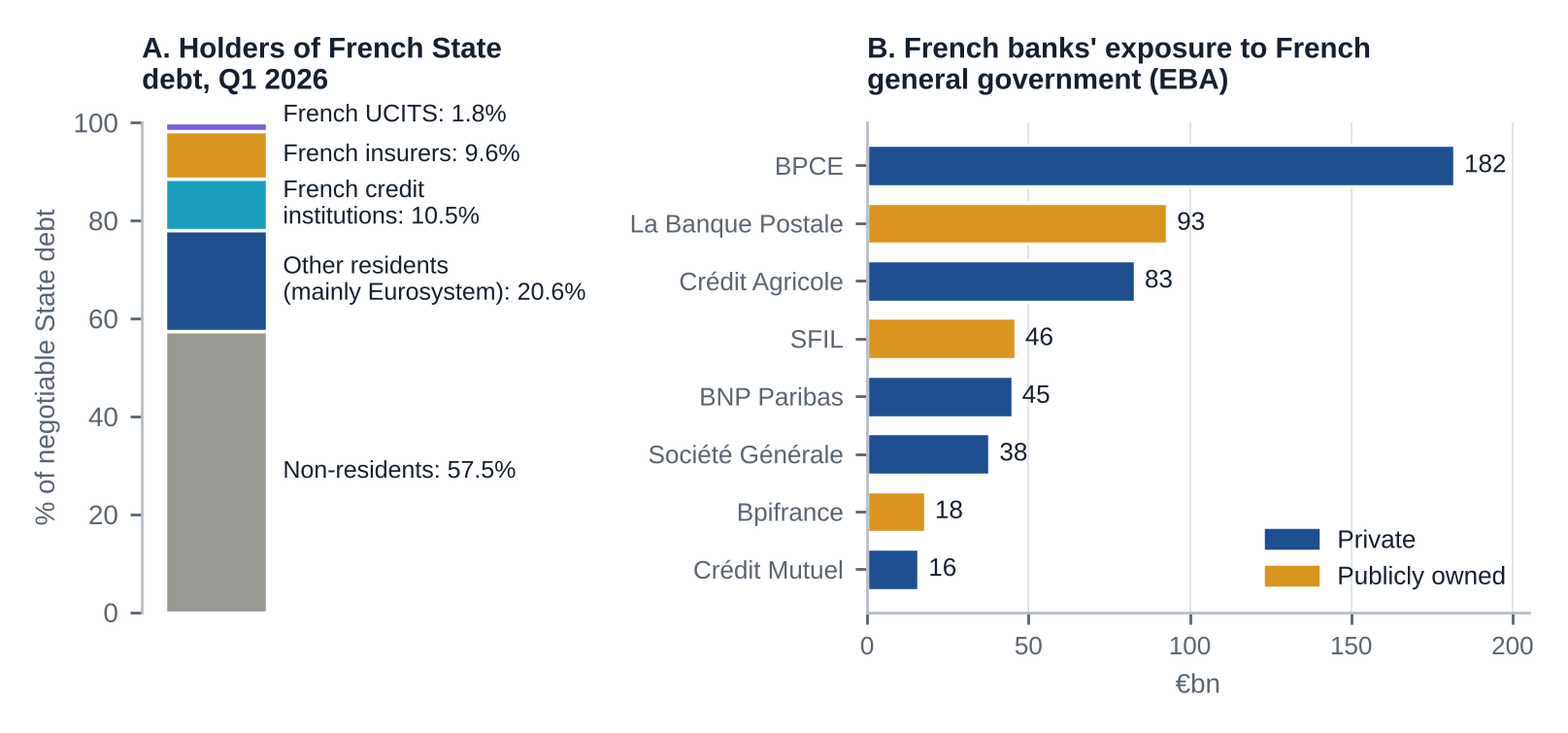
According to the AFT, at the end of Q1 2026 non-residents held 57.5% of negotiable State debt, other residents – essentially the Eurosystem – 20.6%, French credit institutions 10.5%, French insurers 9.6% and French UCITS 1.8%. The Eurosystem is shrinking its share: the Banque de France’s holdings fell from €546bn to €488bn in the first half of 2026 due to the balance sheet roll-off. This is quite significant amount and each euro the Eurosystem stops reinvesting must be absorbed by private investors.
Figure 3 · Who holds French debt, and how exposed are French banks?
Sources: Panel A, Agence France Trésor, Q1 2026, via La Note. Panel B, EBA EU-wide transparency exercise as compiled by Éric Dor (IESEG), via Crédit et Banque; reference date to be confirmed against the EBA database, likely June 2024.
On banks’ exposure, there are several sources to consider. The EBA transparency data show French banks with about €521bn of exposure to French general government, with BPCE alone at €182bn, La Banque Postale at €93bn, Crédit Agricole at €83bn, and BNP Paribas and Société Générale at around €40–45bn each (Figure 3, panel B).
The AFT figure implies that French credit institutions hold only about €285bn of State securities. The differences are largely explained by the fact that the EBA covers the whole of general government (State, local authorities and social security), while the AFT counts only negotiable State debt. The EBA also includes loans and advances, whereas bank quarterly reports typically show government bonds held in the banking/HTM book, net of short positions. The EBA uses gross carrying amounts, largely at amortised cost; the AFT uses market value. So the EBA takes a very expansive view of banks’ exposure.
But the EBA discontinued its transparency exercise after the June 2025 data, pending the release of its new Pillar 3 data hub. The only harmonised, bank-by-bank source on sovereign exposures is going dark at exactly the moment markets want it. On the whole, though, France has some room to mobilise its domestic financial system to weather the shock. Sovereign exposure is 38% of CET1, down from 43% at its peak, and relatively far from Italian or Spanish levels (Figure 4). For good measure, if French banks held as much as Spanish or Italian banks as a percentage of CET1, they could buy €300bn or €500bn more respectively, roughly one to one-and-a-half times total issuance in 2026.
Figure 4 · Banks’ holdings of domestic sovereign bonds, % of capital and reserves

Source: ECB BSI; data as of August 2026.
So, in conclusion, the direct capital risk is smaller than the headline EBA numbers suggest. French banks do not own much sovereign bonds compared with their peers or with their own historical peak, so they have some room to cushion the shock. That said, even if they stepped in with force, bringing French MFIs’ exposure back to historical levels would cover only 15% of total issuance for 2027, so the cushion can only be temporary.
Your distinction between projected and actual imports is important. A further question is how quota rights will be allocated. If the restriction binds, the allocation could determine whether manufacturers, importers or governments capture the scarcity value. Have you seen detail on that mechanism? It seems central to assessing prices and margins, alongside the volume effect. I explore that distinction further here: https://igreaterchina.substack.com/p/europe-can-limit-chinese-cars-can?r=gf5z1&utm_campaign=post&utm_medium=web&showWelcomeOnShare=true